|
Pests and ProtectionWoodlands and forests have their fair share of pests and diseases. Whilst familiar problems of deer, squirrel and rabbit seem to have increasing impact, new diseases have been emerging to affect trees, plantations and ecosystems. For some types of disease, there are a couple of sensible woodland management principles to reduce impact. Variation and Diversity Diversify the structure of woodland compartments so that there is variation of age, height and species of trees. Not only diversify the species but also the seed source and allow a careful element of provenance diversity. Aim to have intimately mixed stands so that if one species/layer/age/genotype/provenance is hit by fungal or bacterial disease, there won't be too much of a gap and others of the same species may have greater tolerance. Thinning Thinning increases light and other resources to selected trees. This strengthens individuals and increases their resistance. Reduced population density also increases ventilation and reduces the fungal environment. Although thinning may alter flight patterns of insect vectors and the potential for carrying pathogens, this is not a consideration for not thinning normally and the major silvicultural benefits it provides. A few increasingly important pests and diseasesAsh dieback Originally discovered in the early 1990s and newly arrived in Britain, spores of fungal pathogen Hymenoscyphus fraxineus have blown across the North Sea from Europe and been brought in on live plants and destined for distribution and sale within the UK. Chalara, as it is now known, affects newly planted trees in particular, which can be killed within one season. It shows as black necrosis on the leaves, veins and leaf stems, and forming long lesions down the length of the sapling stem. Older trees die back over time, eventually leading to death. From February 2012 it has been found on a number of new planting sites in England, and has also been found in established woodland. The disease is established in continental Europe, and in Denmark has claimed about 70% of the ash population. In the UK it has been steadily spreading from the initial outbreak area of East Anglia. For a fuller discussion on silvicultural characteristics, resistance and advice on interim and medium term management, go to the page
Chalara.
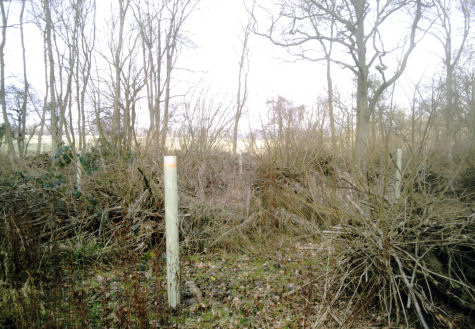
Increasing numbers of deer have been affecting the regeneration of woods throughout Britain. Total populations of roe, fallow, red and muntjac deer have been growing beyond natural woodland carrying capacity, with trees, shrubs and flowers being browsed as they try to establish themselves. Without protection and control, seedlings and re shooting coppice will not come on, and the whole woodland ecosystem can be severely damaged.
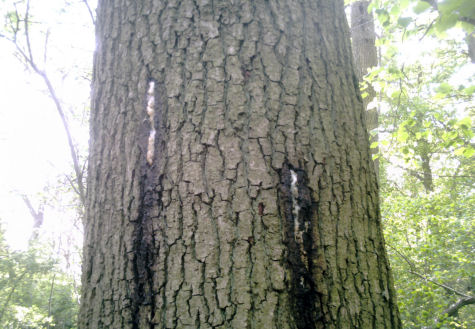
Protection is expensive but may include fencing, electric fencing or use of brash over coppice stools, and tubes. Roe and red deer are native species, and play a part in the natural history of British woodland. However, where total numbers of all species are so damagingly high, landscape level control may be appropriate to reduce populations. Licenced deer stalkers can be engaged where sites are suitable. Acute Oak Decline Cursory and initial observation will find stem bleeding in patches of the lower trunk during the growing season. Over winter, the bleeding area dries up, leaving blackness around loosened bark. The disease is partly due to a newly discovered genus (and species) of bacteria, Gibbsiella quercinecans, although other bacteria may also be involved. The condition generally appears in conjunction with one or two species of Agrillus wood boring insects, which may act as vectors. Dieback and death can be relatively quick.
Much is still unknown about the disease, though environmental change, e.g. warm winters, drought, or underthinned stands, may have been overwhelming oak’s normal resistance. Forest Research are asking owners and managers to report the incidence and location of cases as they arise. More information available on
www.forestresearch.gov.uk/oakdecline
Now called Dothistroma Needle Blight, this is particularly affecting Corsican Pine in Eastern England, though it can also affect the more resistant pine species. Red and yellow bands on the needles indicate the parasitic fungus Dothistroma septosporum, with infection spreading upwards from the lower branches. Incidence increases in warm, wet seasons, which provide good conditions for inoculation and spread of the disease. See Forest Research on
http://www.forestresearch.gov.uk/dothistroma
This fungus is relatively new to Britain, originating possibly in Asia, and was found being nurtured by rhododendron from 2002. Since 2009 it has spread into Japanese larch, with disastrous consequences for larch growers in the Western half of the British Isles. Like many fungi, it thrives in warm wet conditions, dispersing its spores largely through water and moist air. Bleeding cankers become visible on the upper bark, and the shoots wilt, needles blacken and are prematurely shed. There is no cure, and infected trees are felled to eliminate the source of inoculum. See Forest Research on
http://www.forestresearch.gov.uk/pramorum
This moth has spread to Britain from Southern Europe. Larvae feed on the leaves of many oak species, and can severely defoliate the tree. There is also an implication for human health in urban areas. Hairs on the larvae have defensive toxins in them, which can cause not just irritation and allergies, but toxic shock in susceptible people. See Forest Research for more on
http://www.forestresearch.gov.uk/oakprocessionarymoth
|